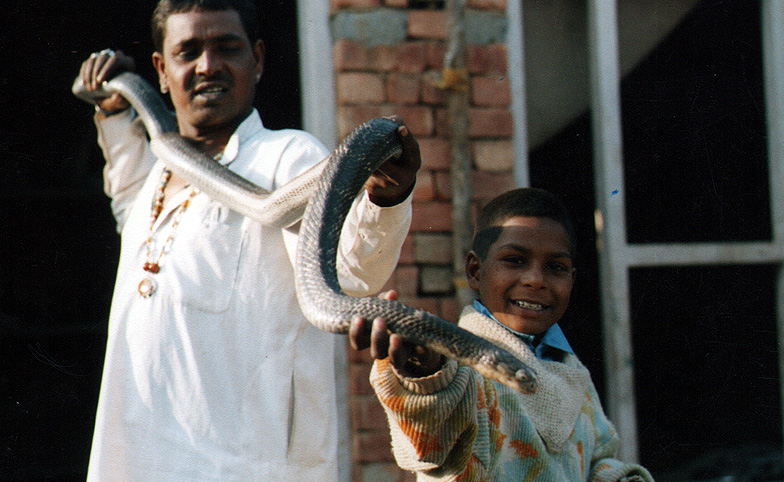
For ten years I worked on one of the most challenging yet rewarding projects of my life. I first visited the snake charmers village in Badarpur on the edge of Delhi and thus started my long term engagement with this community that today symbolizes the tension between wildlife conservation and livelihoods. The snake charmers, for generations have used snakes to earn a living. The snake charmers are cruel to the snakes, quite often resorting to techniques such as defanging the snake or blocking the venom ducts, which causes pain to the snake and also affects its ability to survive in the wild. Their occupation is banned because the use of wild animals is prohibited under the Indian Wildlife Protection Act, 1972 Winning the trust of a community that is engaged in an occupation seen as illegal is not easy. On my first few visits the charmers kept putting snakes in my bag to shoo my away. Little did I know then that I had just started a lifelong engagement with this community and their problems. For two years , I travelled to different snake charmer villages across the states of Haryana, Uttar Pradesh and Rajasthan. We then undertook a comprehensive research project and conducted a survey with 500 families to understand how charmers live today, the snake species they used and the levels of traditional knowledge of the community ( more on that in the Reports section). We approached the government , helped the community get loans, so they could set up shops. I enlisted the help of a theatre director, Roysten Abel, and thus was born a musical band known as ‘ A Hundred Charmers’ . The band has performed in India and abroad and given a sense of self respect to a community that was hounded by enforcement agencies. The snake charmers today are open to change, but the government needs to offer them alternate livelihoods if it wants them to abide by the law.